
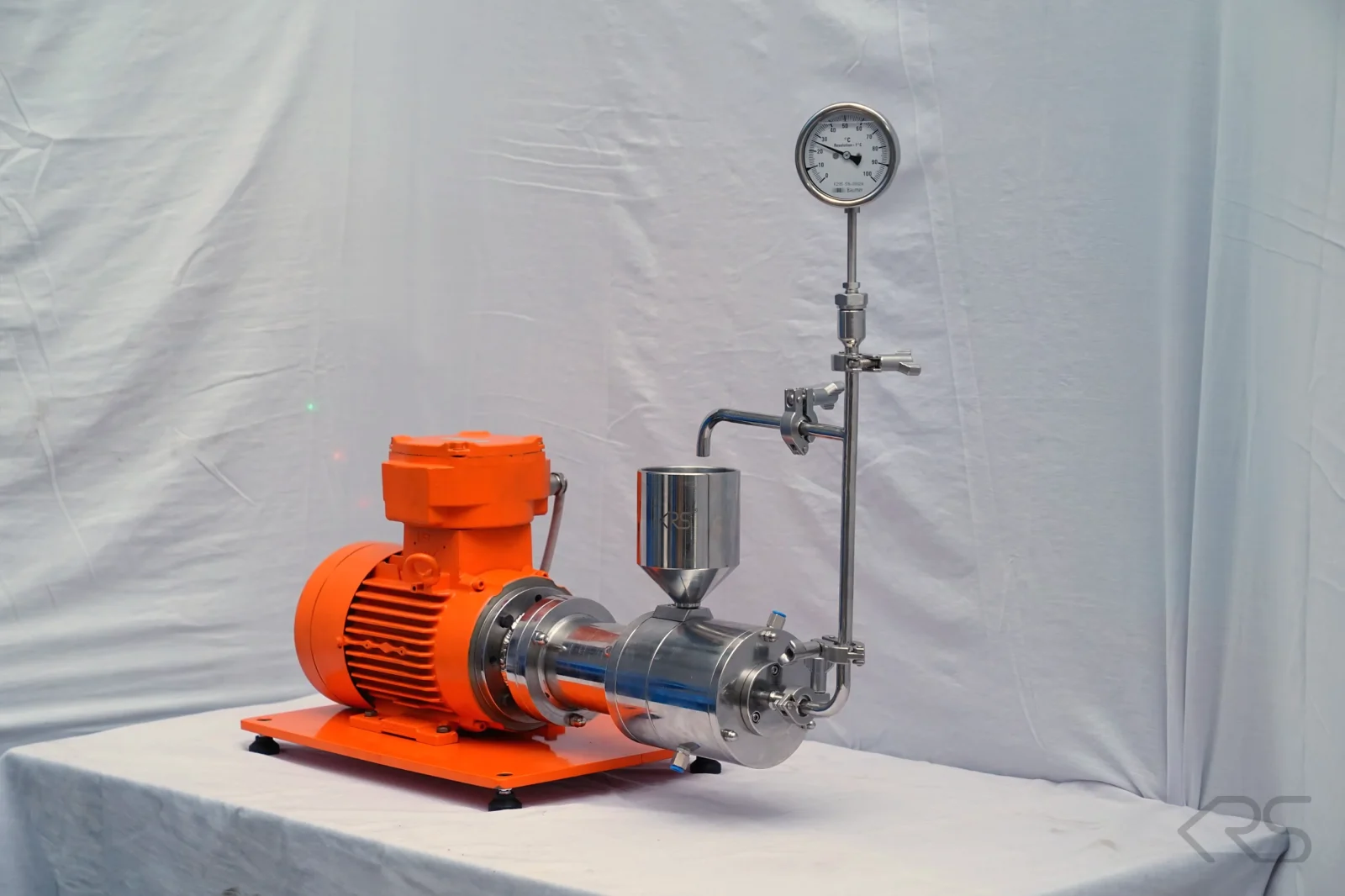
KRS DISPERMAHLTECHNIK Laboratory Bead Mill with stainless steel grinding chamber, feed hopper and dial thermometer

PRODUCTS – LABORATORY BEAD MILLS

Laboratory Bead Mill Manufacturer in India

KRS laboratory bead mills for formulation development, trial grinding and small batches – the laboratory counterpart to KRS High Energy Bead Mills.

OVERVIEW

What is a laboratory bead mill?

A laboratory bead mill works on the same principle as a production bead mill: an agitator moves grinding beads in a closed chamber, and the beads reduce the particle size of a pre-dispersed product. Its small chamber makes it suitable for formulation development, quality control and trial grinding with small sample quantities.

Laboratory Bead Mill for Fine Grinding and Dispersion

KRS DISPERMAHLTECHNIK manufactures laboratory bead mills for fine grinding, particle size reduction and dispersion development. These machines help manufacturers and research teams evaluate formulations before scaling up to production. As a result, users can study their materials and processing requirements at laboratory scale.

Applications of Laboratory Bead Mills

Manufacturers use laboratory bead mills for paint, printing ink, coatings, pigment and chemical processing applications. For example, technical teams can test formulations that require fine particle distribution and consistent dispersion. In addition, laboratory trials help users evaluate processing parameters before choosing production equipment.

Key Benefits of Laboratory Bead Mills

  • Laboratory-scale testing: First, users can test formulations with smaller material quantities before conducting production-scale trials.

  • Fine grinding: Furthermore, the machine helps reduce particle size in suitable materials and formulations.

  • Dispersion development: Similarly, users can evaluate pigment and other solid particles in liquid systems.

  • Process evaluation: As a result, technical teams can compare processing conditions and assess performance.

  • Formulation development: Finally, laboratory testing helps users evaluate new formulations and improve existing products.

Industries and Materials

Laboratory bead mills support research and formulation development in paints, printing inks, industrial coatings, pigments and selected chemical products. However, material properties, formulation, grinding media and operating conditions influence the final results. Therefore, users should evaluate each application according to its specific processing requirements.

How to Choose a Laboratory Bead Mill

When selecting a laboratory bead mill, consider batch size, material viscosity, target particle size, grinding media and cooling requirements. Additionally, identify the intended application and desired processing results before choosing a machine. By sharing these details with our team, you can determine a suitable configuration for your laboratory trials.

Contact KRS DISPERMAHLTECHNIK

Are you looking for a laboratory bead mill for research or product development? Contact KRS DISPERMAHLTECHNIK to discuss your grinding and dispersion requirements. Our team will review your application and help you select a suitable machine configuration based on your processing needs.

Request a Quote

HOW IT WORKS

How a laboratory bead mill works

Grinding chamber

The pre-dispersed sample is fed into a small closed chamber filled with grinding beads.

Bead motion

An agitator sets the beads in motion; impact and shear between them break particles down.

Separation

The beads stay in the chamber while the ground product is collected.

CONSTRUCTION

Machine construction and key features

A KRS laboratory bead mill combines a stainless steel grinding chamber with an agitator driven by a motor on a steel base plate with adjustable feet. The sample is charged through a stainless steel feed hopper; a return line from the chamber outlet leads back over the hopper so that the product can be recirculated, and a dial thermometer on the line shows the product temperature. Pipework connections are made with clamp fittings.

  • Stainless steel grinding chamberSmall chamber for sample and trial quantities
  • Same grinding principle as production bead millsTrial results help with scale-up
  • Stainless steel feed hopperFor charging the sample
  • Recirculation lineFrom the chamber outlet back over the feed hopper
  • Dial thermometerShows the product temperature during grinding
  • Clamp connectionsPipework that is quick to take apart for cleaning
  • Drive on a steel base plateWith adjustable feet for a stable bench set-up

CONFIGURATION

Configured to your requirements

We define these points with you for each machine.

  • Grinding chamberChamber size for your sample and batch quantities
  • Grinding mediaBead type and size for your product
  • Drive and speedAgitator speed range for your application
  • ExecutionSuited to your laboratory environment

Technical data. Specifications for your machine are provided with the quotation, based on your product and process requirements.

INDUSTRIES

Paint, ink, coating and chemical applications

Where KRS laboratory bead mills are used. See all industrial dispersion applications.

  • Paint

    Formulation development and trial grinding of pigment dispersions.

  • Printing ink

    Developing and testing liquid ink formulations before production.

  • Coatings

    Trials for protective, industrial and functional coatings.

  • Pigments

    Testing pigment concentrates and dispersions.

  • Quality control

    Checking batches and raw materials on a small scale.

  • Scale-up

    Defining grinding parameters for transfer to a production bead mill.

MANUFACTURING & INSTALLATION

Built and installed by KRS

Every machine is engineered, fabricated and assembled by KRS in Coimbatore, India, and KRS engineers support installation and commissioning at the customer site.

Manufacturing and engineering at KRS

  • EngineeringMachine configuration for your product and plant
  • ManufacturingFabrication and assembly in the KRS workshop
  • Installation and commissioningSupport at the customer site
  • Process lineCombine with High Energy Bead Mills

PHOTOS

KRS Laboratory Bead Mills in the workshop and on site

FAQ

Questions about laboratory bead mills

Can’t find your answer? Ask our engineers.

What is a laboratory bead mill?

A small bead mill for formulation work and trial grinding. It reduces the particle size of solids dispersed in a liquid on the same principle as a production bead mill, with a much smaller grinding chamber.

What is a laboratory bead mill used for?

For developing and testing formulations, grinding trials with small sample quantities, quality control and preparing the transfer of a product to a production bead mill.

Laboratory or production bead mill – which do I need?

A laboratory bead mill is for development, trials and small batches; a High Energy Bead Mill is for continuous production. Many manufacturers use both: trials on the laboratory mill, production on the larger machine.

Can laboratory results be transferred to production?

The grinding principle is the same, so laboratory trials help to define parameters such as bead size, agitator speed and grinding time for production. The transfer is evaluated for each product.

What information is required for a laboratory bead mill quotation?

Your product and application, viscosity and solids content, typical sample or batch size, target fineness and any requirements of your laboratory.

Request a quote for Laboratory Bead Mills

Tell us about your product, batch size and target result.

Request a Quote