
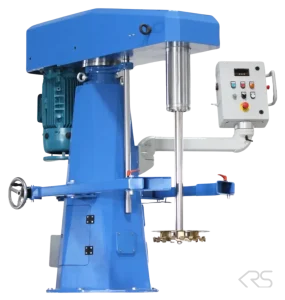
High speed disperser impeller design has a bigger effect on dispersion quality than most operators expect. Two dispersers with the same motor can give very different results in paints, inks and coatings, simply because of the blade type, its diameter, its position in the vessel and the speed at which it runs.
This guide explains how each of these factors works, the rules of thumb used across the industry, and the signs that a blade is no longer doing its job. Treat the figures as typical starting points, and always confirm the right settings for your product with trials.
What the disperser blade actually does
A high speed disperser breaks up agglomerates of pigment and filler and wets them out in the liquid. The blade does this in two ways at once:
- Shear at the blade edge. The teeth of the spinning blade create intense shear and turbulence in a thin zone around the blade. This is where the blade tears agglomerates apart.
- Circulation through the vessel. The blade also pumps the whole batch, pulling material down from the surface and up from the bottom, so that every part of the batch passes repeatedly through the high shear zone.
Good impeller design balances these two jobs. Too little shear and agglomerates survive; too little flow and parts of the batch never reach the blade.
Types of disperser blades
Most blades fall into a few families, each suited to different products and stages of the process.
| Blade type | Shape | Best suited for |
|---|---|---|
| Sawtooth (Cowles-type) | Flat disc with alternating teeth bent up and down at the edge | General pigment dispersion in paints, inks and coatings; the most common design |
| High-shear | Smaller, more numerous teeth for a stronger cutting action | Hard-to-wet pigments and products needing finer initial dispersion |
| High-flow | Larger, angled teeth or vanes that move more volume | Higher-viscosity batches and blending stages where circulation matters more than shear |
| Polymer (e.g. polyethylene) | Plastic disc, usually sawtooth profile | Products that must stay free of metal contact or contamination |
Many manufacturers keep more than one blade type and change blades between dispersion and let-down stages. When choosing, consider the product’s viscosity, how difficult the pigment is to wet, and whether the vessel walls or product are sensitive to wear and contamination.
Tip speed: the most important setting
Tip speed is the speed of the blade’s outer edge, and it determines how much shear the blade produces. It depends on both the blade diameter and the shaft speed:
Tip speed (m/s) = π × blade diameter (m) × shaft speed (rpm) ÷ 60
For example, a 300 mm blade running at 1,450 rpm has a tip speed of 3.1416 × 0.3 × 1,450 ÷ 60 = about 22.8 m/s.
For pigment dispersion, most manufacturers work at a tip speed of roughly 18 to 25 m/s. Below this, shear drops quickly and dispersion takes longer or stays incomplete. Far above it, the extra energy mostly turns into heat and can cause splashing and air entrainment.
Because tip speed depends on diameter, a small blade must turn much faster than a large one to reach the same shear:
| Blade diameter | rpm for 18 m/s | rpm for 22 m/s | rpm for 25 m/s |
|---|---|---|---|
| 150 mm | 2,290 | 2,800 | 3,180 |
| 200 mm | 1,720 | 2,100 | 2,390 |
| 250 mm | 1,380 | 1,680 | 1,910 |
| 300 mm | 1,150 | 1,400 | 1,590 |
| 400 mm | 860 | 1,050 | 1,190 |
| 500 mm | 690 | 840 | 960 |
This is why a variable speed drive is so useful: it lets the operator start slowly while adding powder, then raise the speed to full dispersion tip speed once the pigment has wetted out.
Blade size and vessel geometry
Even at the right tip speed, a blade only works well if it suits the vessel. Engineers widely use these ratios, all based on the blade diameter (D), as starting points:
| Dimension | Typical guideline | Why it matters |
|---|---|---|
| Vessel diameter | About 2.5 to 3 × D | A vessel that is too wide leaves stagnant zones near the walls |
| Blade height above vessel bottom | About 0.5 to 1 × D | Too high and solids settle; too low and the vessel bottom restricts flow under the blade |
| Batch depth | About 1 to 2 × D | Too shallow causes splashing and air; too deep and the top of the batch mixes poorly |
If you use one vessel for very different batch sizes, it may need a different blade diameter or blade position for the smaller batches to keep these proportions.
Getting the right flow pattern
The clearest sign of a well set-up disperser is the “rolling doughnut” flow. The batch surface forms a ring that rolls steadily inward towards the shaft, with a small vortex in the centre just exposing the top of the blade or shaft.
- No visible movement at the walls: the batch is too viscous for the blade, or the blade is too small or too slow. Increase speed or check the blade size.
- A deep vortex reaching the blade: the speed is too high for the batch depth, and the vortex pulls air into the product. Reduce speed or raise the batch level.
- Splashing at the surface: the blade is too close to the surface or the batch is too shallow.
Signs of a worn blade
Blade teeth wear gradually, especially with abrasive pigments and fillers. Because wear reduces both the effective diameter and the cutting edges, a worn blade gives lower shear at the same rpm. Watch for:
- Dispersion times getting longer for the same formulation
- Fineness of grind (Hegman gauge) readings that are coarser than before
- Rounded, thinned or bent teeth, or a blade that runs unevenly
Checking blades at regular intervals and replacing them before results drift keeps batches consistent.
When a disperser is not enough
A high speed disperser is ideal for wetting pigments, breaking agglomerates and premixing. Its job is not to reduce primary particle size. When a product needs a very fine, consistent grind, a milling step usually follows dispersion:
- A bead mill for fine particle size reduction in paints, inks, coatings and pigment concentrates.
- A three roll mill for high-viscosity pastes and printing inks.
A good premix from the disperser makes the milling step faster and more consistent, so the two machines work best together.
Talk to KRS DISPERMAHLTECHNIK
KRS DISPERMAHLTECHNIK manufactures high speed dispersers for paints, inks, coatings and chemicals in Coimbatore, India. If you are choosing a new disperser or want to improve results on your current process, contact our team to discuss your product and batch sizes.