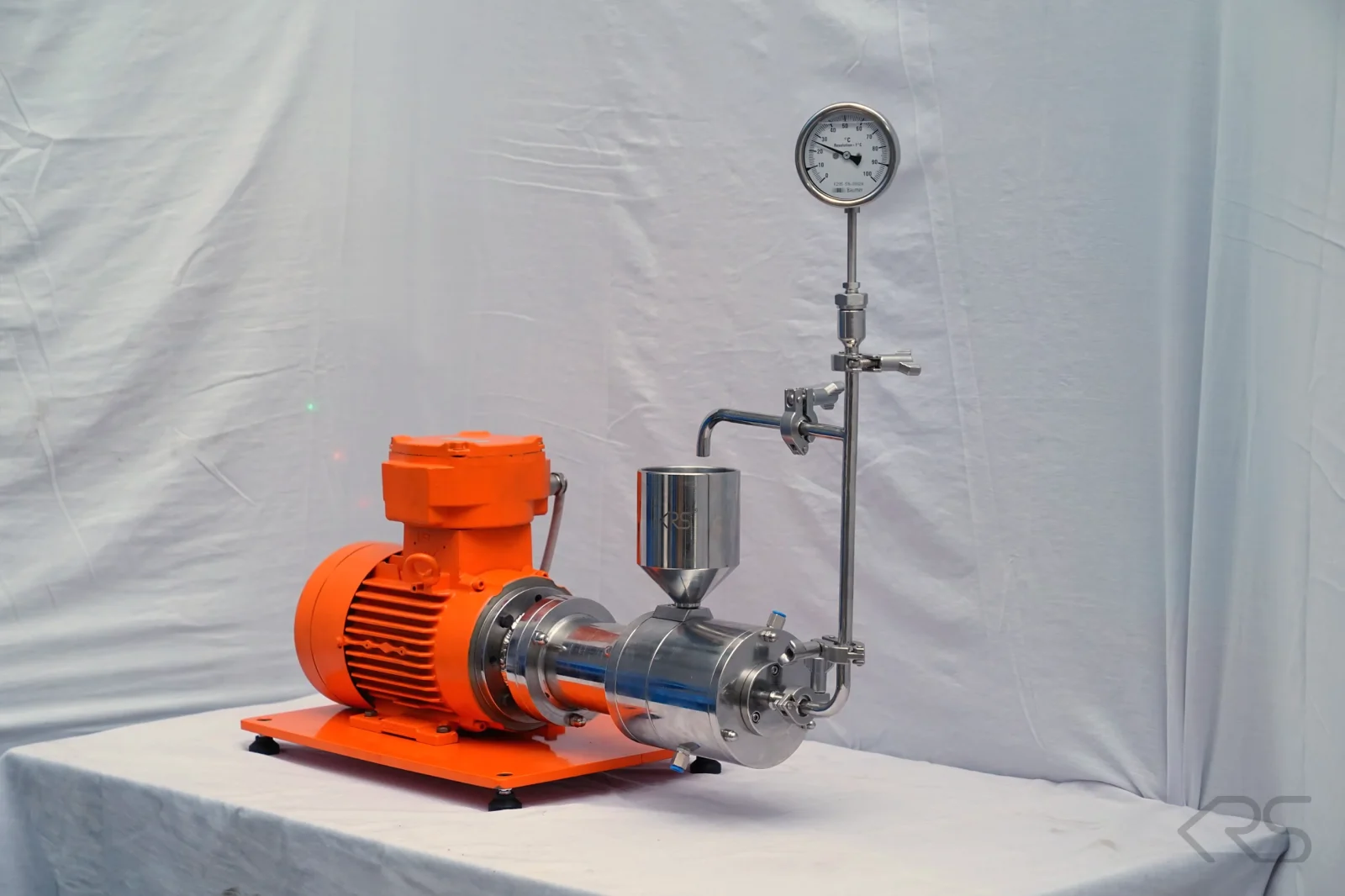
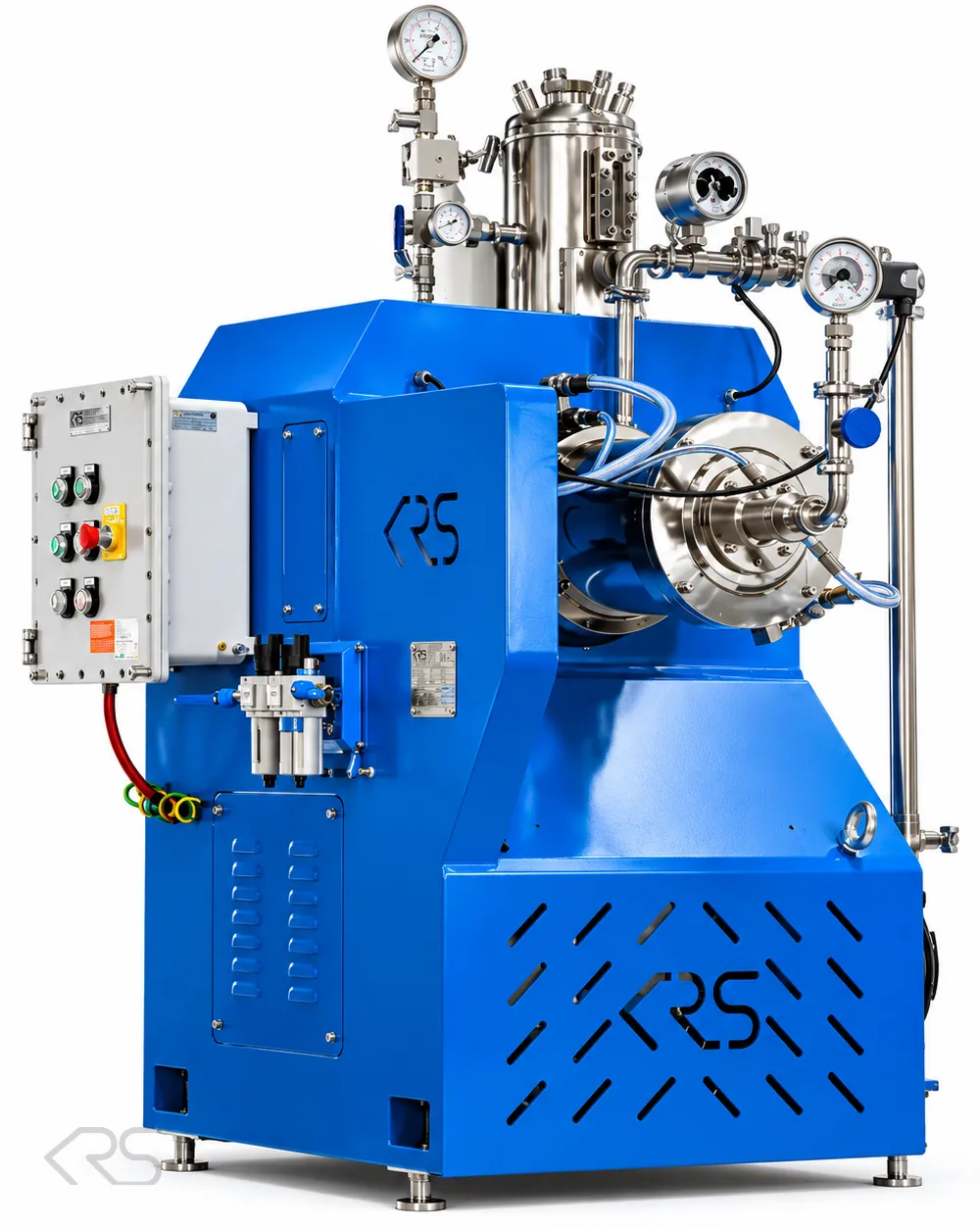
Bead Mill Manufacturer in India – High Energy Bead Mills for Fine Grinding & Dispersion
KRS DISPERMAHLTECHNIK is a bead mill manufacturer in India, specialising in the design and manufacturing of high energy horizontal bead mills for wet grinding, fine particle size reduction and dispersion of industrial formulations. Based in Coimbatore, Tamil Nadu, we manufacture bead mill machines for applications in paints, printing inks, coatings, pigments, specialty chemicals and advanced materials.
Our bead mills use mechanical energy and grinding media to reduce particle size and improve the distribution of solid particles in liquid formulations. They are suitable for industrial processes where consistent dispersion, controlled fineness and reliable production performance are important.
Whether you require a bead mill for pigment grinding, fine ink dispersion, coating production or specialised nano-grinding applications, selecting the right machine depends on your material characteristics, target particle size and production requirements.
What Is a Bead Mill?
A bead mill is an industrial wet grinding machine used to reduce the particle size of solid materials dispersed in a liquid medium. It consists of a grinding chamber containing small grinding beads and an agitator that generates movement within the chamber.
During operation, the agitator transfers mechanical energy to the grinding media. The movement of the beads produces repeated impact and shear forces, helping break down particle agglomerates and achieve a finer, more uniform dispersion.
Bead mills are commonly used after the initial dispersion stage, when a high speed disperser alone cannot achieve the required fineness.
In paint manufacturing, printing ink production, pigment processing and coatings manufacturing, bead milling is an important process for achieving the desired particle size distribution and product quality.
How Does a Bead Mill Work?
A high energy bead mill operates through the controlled movement of grinding media inside a closed milling chamber.
The wet grinding process generally involves the following stages:
1. Product Feeding
The pre-dispersed material is supplied to the horizontal grinding chamber using a suitable feed pump. The formulation must have appropriate flow and viscosity characteristics for the selected machine.
2. Grinding Media Movement
Inside the chamber, an agitator drives the grinding beads into motion. Mechanical energy is transferred to the media, creating intensive interactions within the product.
3. Particle Size Reduction
The moving beads generate impact and shear forces that help break down particle agglomerates and reduce particle size. The degree of grinding depends on the media size, agitator speed, processing time and formulation properties.
4. Bead Separation and Product Discharge
A separation system at the chamber outlet retains the grinding beads while allowing the processed liquid product to pass through.
Depending on the process arrangement, the material can be processed in a suitable flow or circulation configuration to achieve the required fineness.
Bead Mill for Nano Grinding Applications
A bead mill for nano grinding is used in specialised wet milling applications where the objective is to achieve sub-micron or nanoscale particle sizes in suitable liquid formulations.
Nano grinding requires more than simply increasing the machine speed. It involves careful selection of grinding media, chamber design, separator configuration and operating conditions.
Small-diameter grinding media can provide more frequent interactions with fine particles. However, achieving nanoscale results also depends on material properties, energy input, viscosity, temperature management and the stability of the final dispersion.
Important considerations for nano grinding include:
-
Grinding media size: Smaller media may be required for fine and nanoscale grinding applications.
-
Media material: Grinding media must be selected according to material compatibility, wear characteristics and contamination requirements.
-
Agitator performance: The milling system must transfer sufficient energy to the grinding media.
-
Separation system: The outlet separator must be compatible with the selected media size.
-
Temperature management: Heat generated during intensive milling must be controlled, particularly for temperature-sensitive formulations.
-
Particle size measurement: The final result should be evaluated using an appropriate particle-size measurement method.
Not every bead mill or formulation is suitable for true nanoscale grinding. The achievable particle size must be established based on the machine configuration and application-specific process evaluation.
KRS DISPERMAHLTECHNIK can discuss your fine-grinding requirements and help identify a suitable bead mill configuration.
Applications of Industrial Bead Mills
Bead mills are widely used in industries where fine wet grinding, particle size reduction and uniform dispersion are important.
1. Paint Manufacturing
In decorative and industrial paint manufacturing, bead mills are used for fine grinding and dispersion of pigment-based formulations. Proper milling helps achieve the required fineness, colour development and dispersion consistency.
2. Printing Ink Manufacturing
Liquid printing ink production requires controlled pigment dispersion and particle size distribution. Bead mills are used in processing suitable formulations for printing applications, including liquid inks.
3. Coatings Industry
Industrial and protective coatings often require fine dispersion of pigments, fillers and other solid ingredients. Bead milling helps achieve the required dispersion quality and formulation consistency.
4. Pigment Processing
Bead mills are used for wet grinding pigment dispersions and reducing agglomerates. Grinding conditions influence particle distribution and the final characteristics of the pigment formulation.
5. Specialty Chemicals
Selected chemical suspensions and liquid formulations require intensive wet milling to achieve the desired particle size and distribution.
6. Advanced Materials
Fine grinding and dispersion equipment is used in selected advanced-material applications where controlled particle size and uniform distribution are important.
The suitability of a bead mill depends on the formulation, material compatibility and required processing results.
Key Features of KRS Bead Mills
KRS DISPERMAHLTECHNIK manufactures horizontal bead mills with configurations designed around industrial wet grinding and dispersion requirements.
Depending on the selected machine and application, the equipment includes the following features:
Horizontal Grinding Chamber
A closed horizontal chamber houses the grinding media and provides the working zone for wet milling.
Agitator Assembly
The agitator generates movement of the grinding beads and transfers mechanical energy to support particle size reduction.
Grinding Media Separation
A separation system at the outlet retains the grinding media while allowing the processed product to discharge.
Product Feed System
A suitable feed pump and flow-control arrangement can be selected according to the formulation and process requirements.
Process Monitoring
Pressure gauges on the product circuit and an operator control panel support monitoring and operation of the machine.
Cooling Arrangement
Cooling provisions can be considered for formulations where temperature control is important during grinding.
Laboratory and Production Models
KRS offers laboratory bead mills for processing evaluation and production bead mills for industrial manufacturing requirements.
Flameproof Execution
Flameproof execution is available for plants where the operating environment and application require it. The specification must be established for the intended installation.
Benefits of Using a High Energy Bead Mill
Choosing an appropriately configured bead mill can support several important manufacturing objectives.
-
Fine particle size reduction: Helps reduce particle agglomerates and achieve the required fineness.
-
Improved dispersion quality: Supports more uniform distribution of solid particles in liquid formulations.
-
Process consistency: Repeatable operating conditions help maintain product quality across production runs.
-
Industrial processing: Supports wet grinding requirements in industrial manufacturing operations.
-
Flexible applications: Suitable configurations can be selected for different paints, inks, coatings and chemical formulations.
-
Process integration: Can be used downstream of high speed dispersers as part of an integrated manufacturing process.
Actual performance depends on the formulation, machine configuration, grinding media and operating conditions.
How to Select the Right Bead Mill
Selecting the correct bead mill is important for achieving the required grinding performance and production output.
Before purchasing an industrial bead mill, consider the following technical parameters:
1. Target Particle Size
Identify the required final particle size and distribution. Specify whether your application requires conventional fine grinding, sub-micron grinding or nanoscale processing.
2. Product Viscosity
The viscosity and flow behaviour of the material influence pumping, circulation and grinding performance.
3. Production Capacity
Define the required production throughput and operating schedule to establish the appropriate grinding chamber configuration.
4. Grinding Media
Select suitable bead material and diameter according to the formulation, desired fineness and contamination requirements.
5. Temperature Control
Evaluate whether cooling is required to maintain product temperature during the grinding process.
6. Product Compatibility
Consider material compatibility with the wetted components and grinding media to minimise contamination and unwanted interactions.
7. Operating Environment
Determine whether standard or flameproof execution is required for the installation.
Discussing these parameters with an experienced bead mill manufacturer helps identify an appropriate machine configuration for your production requirements.
KRS DISPERMAHLTECHNIK – Bead Mill Manufacturer in India
KRS DISPERMAHLTECHNIK is an industrial machinery manufacturer based in Coimbatore, Tamil Nadu, India. We specialise in dispersion and grinding equipment for the paint, printing ink, coatings, pigment and chemical industries.
Our bead mills are engineered, fabricated and assembled at our manufacturing facility. Machine configurations are developed according to application requirements, production capacity and processing objectives.
Our engineering and manufacturing capabilities include:
-
Application-based machine configuration.
-
Horizontal grinding chamber and agitator assemblies.
-
Grinding media and separation arrangements.
-
Product feed and flow-control configuration.
-
Cooling provisions according to application requirements.
-
Installation and commissioning support.
We also manufacture complementary industrial processing equipment, including high speed dispersers and hydraulic three-roll mills.
For manufacturers establishing a new production line or upgrading existing equipment, our team can help evaluate suitable grinding and dispersion machinery.
Integrated Grinding and Dispersion Solutions
A typical paint, ink or coating manufacturing process may involve multiple stages of material preparation and processing.
High Speed Disperser – Pre-dispersion
Used for wetting, incorporating and initially dispersing powders and pigments into liquid formulations.
High Energy Bead Mill – Fine Grinding
Used for further particle size reduction and fine dispersion of suitable liquid formulations.
Hydraulic Three-Roll Mill – Paste Processing
Used for controlled dispersion and refining of high-viscosity pastes and selected printing ink formulations.
Selecting the correct equipment for each processing stage helps establish an effective manufacturing process.
For accurate particle size evaluation, manufacturers should consider particle size distribution parameters such as D10, D50 and D90. These measurements help assess the fineness and distribution of particles after the grinding process. Refer to HORIBA’s technical guide on Setting Particle Size Specifications for additional information.
Frequently Asked Questions About Bead Mills
1. What is a bead mill used for?
A bead mill is used for wet grinding, fine particle size reduction and dispersion of solid materials in liquid formulations. Common applications include paints, printing inks, coatings, pigments and specialty chemicals.
2. What is a high energy bead mill?
A high energy bead mill is a wet grinding machine that transfers mechanical energy to grinding media through an agitator. The resulting impact and shear forces help reduce particle size and improve dispersion.
3. Can a bead mill be used for nano grinding?
Yes, appropriately designed bead milling systems can be used for nanoscale processing of suitable formulations. Achieving the required particle size depends on media size, separator design, energy input, formulation properties and process conditions. Actual performance must be validated for the application.
4. Which industries use bead mill machines?
Bead mills are used in paint manufacturing, printing ink production, coatings, pigment processing, specialty chemicals and selected advanced-material applications.
5. What is the difference between a bead mill and a high speed disperser?
A high speed disperser is mainly used for mixing, powder incorporation, wetting and pre-dispersion. A bead mill provides additional grinding action through moving media to achieve finer particle size reduction and dispersion.
6. What is the difference between a bead mill and a three-roll mill?
A bead mill is generally used for wet grinding and dispersion of pumpable liquid formulations. A three-roll mill is generally used for refining and dispersing high-viscosity pastes through shear between three rolls.
7. What grinding media are used in bead mills?
Grinding media can be selected from suitable materials such as zirconia, ceramic, glass or other compatible media depending on the application, required fineness and contamination considerations. The appropriate media must be selected for the particular machine and formulation.
8. How do I select the right bead mill capacity?
Selection depends on product viscosity, solids content, target particle size, required throughput, grinding conditions and operating schedule. Providing these details to the manufacturer helps determine a suitable machine configuration.
9. Does KRS DISPERMAHLTECHNIK manufacture bead mills in India?
Yes. KRS DISPERMAHLTECHNIK engineers, fabricates and assembles industrial bead mills at its manufacturing facility in Coimbatore, Tamil Nadu, India.
10. What information should I provide when requesting a bead mill quotation?
Please share the following details:
-
Product and application.
-
Material viscosity and solids content.
-
Required particle size or fineness.
-
Required production capacity.
-
Operating hours and production requirements.
-
Any cooling or flameproof requirements.
These details help our engineering team understand your process and recommend a suitable machine configuration.
Enquire About KRS Bead Mills
Looking for a reliable bead mill manufacturer in India for industrial wet grinding, fine dispersion or specialised nano-grinding applications?
Contact KRS DISPERMAHLTECHNIK to discuss your product, particle-size requirements and production capacity.
Our engineering team can help you evaluate the appropriate bead mill configuration for your manufacturing process.
KRS DISPERMAHLTECHNIK
Coimbatore, Tamil Nadu, India.
Request a Quote | Contact Our Engineering Team