
Three Roll Mill Manufacturer in India | Triple roll mill Manufacturer in India
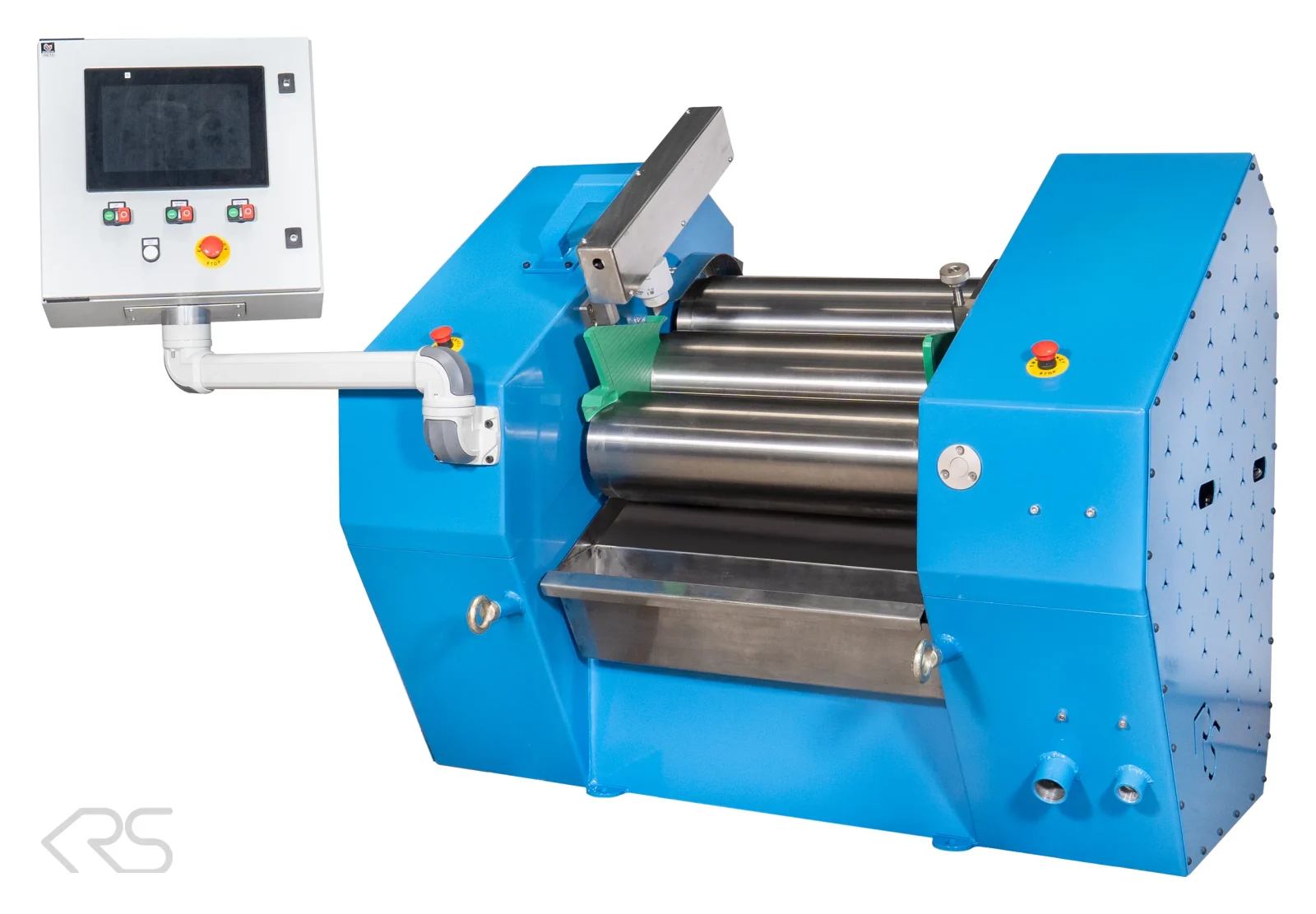
KRS DISPERMAHLTECHNIK manufactures hydraulic three-roll mills for industrial grinding, refining and dispersion applications. Our machinery is designed for processing printing inks, paints, pigments, coatings and other suitable industrial formulations.
A three-roll mill uses three horizontally arranged rollers rotating at different speeds to generate shear forces. This action helps break down agglomerates, improve material uniformity and achieve the required dispersion quality in suitable formulations.
Our equipment is developed to support manufacturers seeking controlled processing of high-viscosity materials and paste-like products. Machine selection depends on the formulation, required fineness, production capacity and operating conditions.
How Does a Three Roll Mill Work?
A three roll mill consists of three precision-engineered rollers arranged horizontally. The rollers rotate at different speeds, creating shear forces as the material passes through the narrow gaps between them.
First, the material is introduced between the feed roller and the centre roller. As the rollers rotate at different speeds, the material experiences shear that helps break down agglomerates and improve dispersion. The material then passes through the second roller gap for further processing before being collected from the discharge roller.
The roller gap, speed ratio, processing conditions, and material characteristics influence the final results. Operators must select appropriate settings according to the formulation, viscosity, and required fineness.
Applications of Three Roll Mills
KRS hydraulic three roll mills are suitable for a range of industrial applications where controlled grinding and dispersion are required.
-
Printing inks: Help achieve uniform pigment dispersion and consistent ink quality.
-
Paints and coatings: Support the refining of suitable pigment-based formulations.
-
Pigments: Assist in breaking down agglomerates and improving particle distribution.
-
Specialty chemicals: Process suitable high-viscosity materials that require intensive shear.
-
Industrial pastes: Support the processing of selected thick formulations and paste-like materials.
The suitability of a three roll mill depends on the material properties, production requirements, and selected machine configuration.
Key Features of KRS Hydraulic Three Roll Mills
Hydraulic three roll mills are designed to provide controlled roller pressure and accurate adjustment of the working gaps. Depending on the selected model, important features may include:
-
Three-roller processing system: Uses differential roller speeds to generate shear for dispersion and refining.
-
Hydraulic pressure adjustment: Supports controlled roller loading according to the machine design.
-
Adjustable roller gaps: Allows operators to set suitable processing conditions.
-
Industrial construction: Designed for demanding manufacturing environments.
-
Application-specific configurations: Helps accommodate different production requirements and material characteristics.
Actual features, available options, and technical specifications depend on the selected model.
Benefits of Using a Three Roll Mill
A properly selected three roll mill can help manufacturers improve process control and achieve consistent material quality.
Fine dispersion: The high shear generated between the rollers helps break down agglomerates in suitable formulations.
Improved uniformity: Multiple processing stages can support more consistent pigment distribution throughout the material.
Controlled processing: Operators can adjust roller gaps and operating conditions to suit the formulation.
Suitable for viscous materials: Three roll mills are particularly useful for selected pastes and high-viscosity formulations that require intensive shear.
Repeatable production: Appropriate operating procedures and process settings help maintain consistency between batches.
The actual performance depends on the formulation, initial particle condition, machine configuration, and operating parameters.
How to Select the Right Triple roll mill
Selecting the right machine requires an understanding of your production process and material characteristics.
Material viscosity: Consider the viscosity and flow behaviour of the formulation during processing.
Required fineness: Define the desired dispersion quality and particle-size requirements before selecting the equipment.
Production capacity: Evaluate batch size, production frequency, and the required processing throughput.
Roller material and dimensions: Select suitable roller specifications based on the formulation, compatibility requirements, and application.
Hydraulic system and gap adjustment: Consider the level of control required for roller pressure and working gaps.
Maintenance and cleaning: Review access to rollers, cleaning procedures, and routine maintenance requirements.
Discussing these factors with the manufacturer helps identify a suitable machine configuration.
Technical Principles of Roll Milling
Three roll mills use differential roller speeds and narrow gaps to generate high shear, helping disperse pigments and reduce agglomerates in suitable formulations. These principles are important in the processing of printing inks, paints, and high-viscosity materials. For additional technical background, read this overview of roll mill technology.
Three Roll Mill Manufacturer for Industrial Dispersion
KRS DISPERMAHLTECHNIK provides industrial dispersion and grinding equipment for manufacturers working with paints, printing inks, pigments, coatings, and suitable specialty formulations. We help customers evaluate their application requirements and identify appropriate equipment for their production processes.
Whether you are establishing a new manufacturing facility or upgrading existing equipment, choosing the right three roll mill begins with understanding your material, required fineness, production capacity, and process objectives.
Looking for a Three Roll Mill Manufacturer in India? Contact KRS DISPERMAHLTECHNIK to discuss your application and explore a suitable hydraulic three roll mill solution.
Visit our KRS DISPERMAHLTECHNIK website to learn more about our industrial mixin