
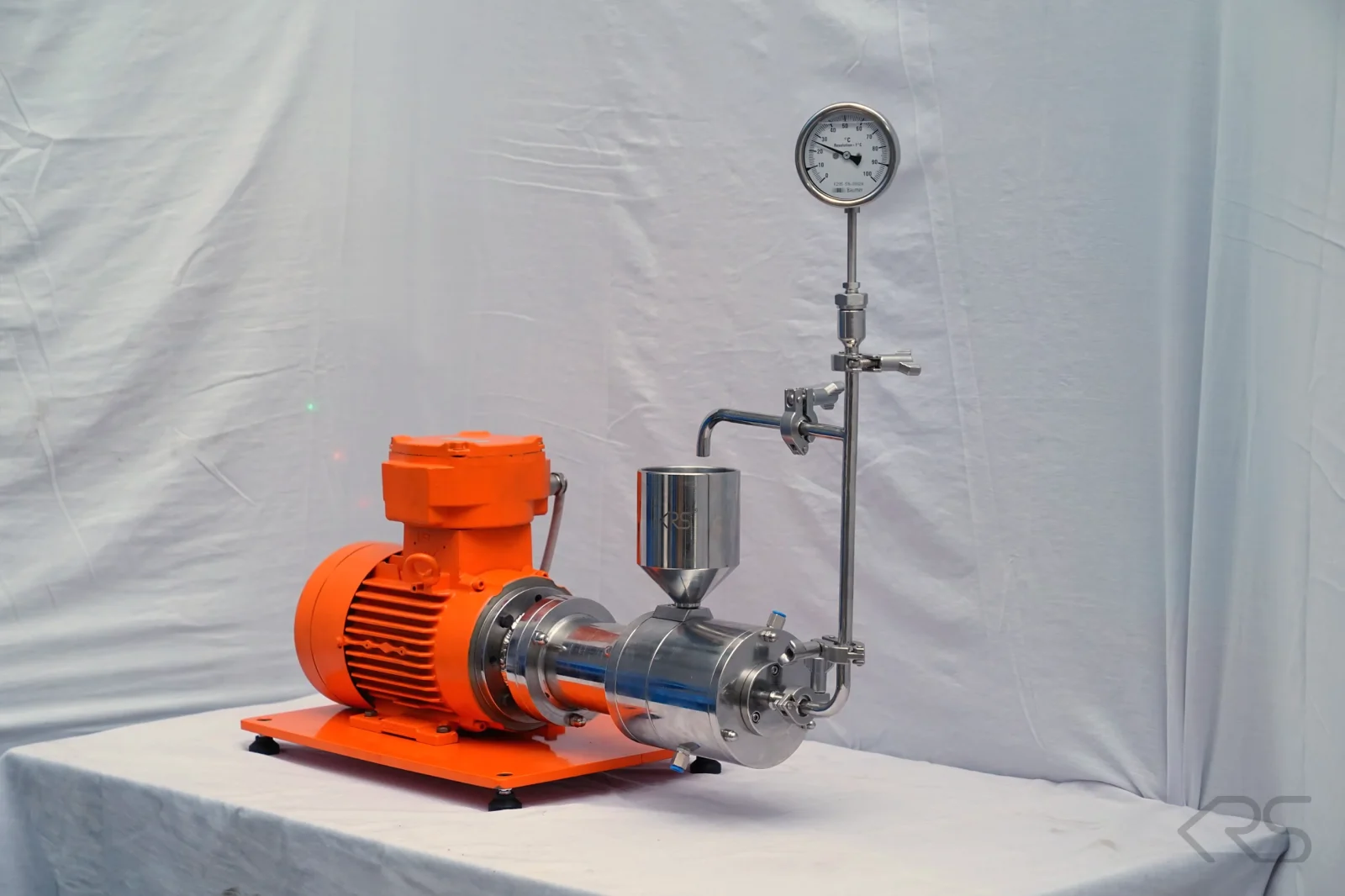
Laboratory Bead Mill Manufacturer in India
KRS DISPERMAHLTECHNIK manufactures laboratory bead mills for fine grinding, particle size reduction, and dispersion development. These machines help manufacturers, research laboratories, and product development teams evaluate formulations before scaling up to production. Laboratory bead mills allow users to study material behaviour, compare processing conditions, and develop suitable grinding and dispersion processes using smaller material quantities.
Laboratory-scale testing is particularly valuable for paints, printing inks, coatings, pigments, and suitable chemical formulations where particle size and dispersion quality influence the final product properties.
How Does a Laboratory Bead Mill Work?
A laboratory bead mill uses grinding media inside a milling chamber to reduce particle size and disperse solid particles within a liquid formulation. The machine applies mechanical energy through the movement of the grinding media, creating impact and shear forces during processing.
First, the material is introduced into the milling system according to the machine’s operating procedure. As the mill operates, the grinding media move through the chamber and interact with the material. These interactions help break down particle agglomerates and reduce particle size in suitable formulations.
The resulting dispersion depends on several factors, including grinding media size, milling speed, processing time, material viscosity, and the properties of the formulation. Laboratory trials allow operators to evaluate these parameters and identify suitable processing conditions.
Applications of Laboratory Bead Mills
Laboratory bead mills support formulation development and process evaluation across several industries.
-
Paints and coatings: Evaluate pigment dispersion and grinding conditions for suitable coating formulations.
-
Printing inks: Develop and test ink formulations that require fine particle distribution.
-
Pigments: Study particle size reduction and dispersion behaviour in liquid systems.
-
Specialty chemicals: Process suitable chemical formulations that require fine grinding or dispersion.
-
Research and development: Conduct controlled trials to investigate new formulations and processing methods.
These applications help technical teams understand how materials respond to different milling conditions before selecting equipment for larger production batches.
Key Benefits of Laboratory Bead Mills
Laboratory bead mills offer several advantages during product development and process optimisation.
Laboratory-scale testing: Evaluate formulations using smaller material quantities before proceeding to larger production trials.
Fine grinding capability: Help reduce particle size and break down agglomerates in suitable materials.
Dispersion development: Allow researchers to investigate how milling conditions influence pigment distribution and formulation quality.
Process comparison: Enable teams to compare different speeds, milling times, and grinding media configurations.
Formulation optimisation: Support the development of new products and improvements to existing formulations.
Scale-up evaluation: Generate useful process information for assessing the requirements of production-scale milling equipment. However, laboratory results should be validated during scale-up because larger machines can behave differently.
How to Choose the Right Laboratory Bead Mill
Selecting a suitable laboratory bead mill requires careful consideration of the material, target results, and intended application.
Material characteristics: Identify the formulation’s viscosity, solid content, initial particle size, and compatibility with the milling system.
Target particle size: Define the required particle size or fineness and the dispersion quality needed for the final product.
Batch capacity: Choose a laboratory system that accommodates the sample quantities required for development and testing.
Grinding media: Consider suitable media material and size based on the formulation, milling objective, and equipment design.
Operating conditions: Evaluate the required milling speed, processing time, temperature control, and cooling arrangements.
Future production requirements: Consider how laboratory results will be used to select or optimise production-scale equipment.
Discussing these factors with the manufacturer helps identify an appropriate machine configuration for your laboratory requirements.
Laboratory Bead Mill for Research and Product Development
Laboratory bead mills are valuable tools for manufacturers who need to develop formulations, investigate grinding performance, and evaluate dispersion quality before commercial production. By conducting controlled laboratory trials, technical teams can compare processing conditions, understand material behaviour, and establish suitable parameters for further testing.
Effective bead milling involves breaking down particle agglomerates and distributing solid particles throughout a liquid formulation. The grinding process and operating conditions influence the final particle size and dispersion quality. For further technical information, read this guide to pigment dispersion and grinding, published in the Journal of the Japan Society of Colour Material.
KRS DISPERMAHLTECHNIK supports industrial customers working with paints, printing inks, coatings, pigments, and suitable chemical formulations. Our team can help assess your application requirements and identify a suitable laboratory milling configuration.
Looking for a Laboratory Bead Mill Manufacturer in India? Contact KRS DISPERMAHLTECHNIK to discuss your material, target particle size, sample quantity, and grinding requirements.
Visit our KRS DISPERMAHLTECHNIK website to learn more about our industrial grinding and dispersion equipment.